Solving techniques
Every logic technique GridDay’s Smart Hint can teach — from your first naked single to expert chains. The same reasoning powers the in-app hints, so the site doubles as a guide.
Beginner
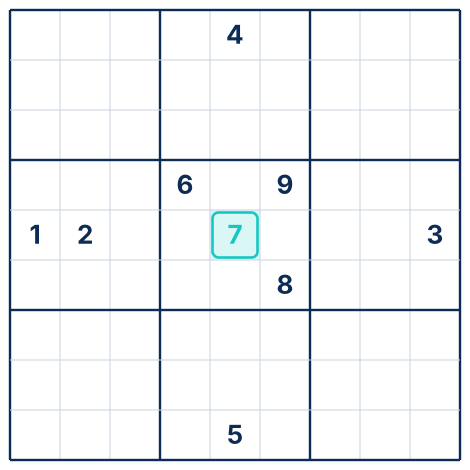
Naked Single
Places a digit Used in: Sudoku, Killer Sudoku, Calcudoku, Futoshiki
Look at a single empty cell and rule out every digit blocked by the puzzle’s constraints — its row, its column, and any box, cage, or inequality it belongs to. When only one digit survives, that cell is solved — there is literally no other number it can hold. This is the most fundamental move in every grid puzzle.

Hidden Single
Places a digit Used in: Sudoku, Killer Sudoku, Calcudoku, Futoshiki
Instead of looking at one cell, look at one digit across a whole row, column, or box. If every empty cell but one is blocked from holding that digit, it is forced into the cell that remains — even though that cell still shows several pencil marks. The digit is “hidden” among other candidates until you scan the unit.
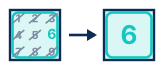
Last Candidate
Places a digit Used in: Sudoku, Killer Sudoku, Calcudoku, Futoshiki
After previous candidate eliminations, a cell may be left with a single remaining possibility. That last candidate is forced, so place it — the earlier cleanup has already ruled everything else out.
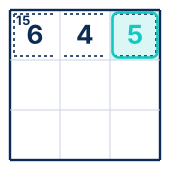
Cage Remainder
Places a digit Used in: Killer Sudoku, Kakuro
A cage or run has a fixed total. When only one cell is still empty, its value is simply that total minus the digits already placed — a group summing to 15 with a 6 and a 4 must finish with a 5. The same move is called Cage Completion in Killer Sudoku and Run Total in Kakuro.
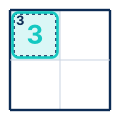
Single-Cell Cage
Places a digit Used in: Calcudoku
A cage made of a single cell has nothing to combine with, so its clue fixes the cell’s value outright. Spotting these first gives you free anchors to build the rest of the solve around.
Intermediate
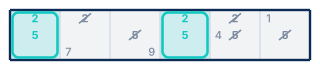
Naked Pair
Removes candidates Used in: Sudoku, Killer Sudoku, Calcudoku, Futoshiki
Two cells in the same unit show the same two candidates and nothing else — say {2,5}. Between them they will use up both of those digits, so 2 and 5 can be erased from every other cell in that unit. You haven’t placed a digit, but you’ve sharpened the whole unit.

Hidden Pair
Removes candidates Used in: Sudoku, Killer Sudoku, Calcudoku, Futoshiki
Two digits appear as candidates in only two cells of a unit. Those two cells must take those two digits, so every other candidate can be cleared out of them. The pair is “hidden” because each of the two cells also shows extra pencil marks that turn out to be impossible.
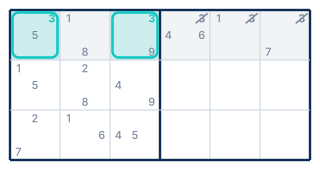
Pointing Pair
Removes candidates Used in: Sudoku, Killer Sudoku
Inside one box, all candidates for a digit lie on a single row (or column). The digit must therefore end up on that line within the box, which means it cannot appear anywhere else along the same line outside the box — remove it there.
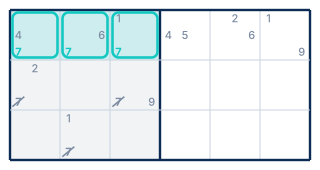
Box-Line Reduction
Removes candidates Used in: Sudoku, Killer Sudoku
The mirror image of a pointing pair. A digit’s only candidates in a row (or column) all fall inside one box. The digit is then locked to that box, so it can be erased from the box’s other two lines.

Naked Triple
Removes candidates Used in: Sudoku, Killer Sudoku, Calcudoku, Futoshiki
Three cells in a unit between them hold only three candidate digits (each cell shows two or three of them). Those three digits are reserved for those three cells, so they can be removed from every other cell in the unit.

Hidden Triple
Removes candidates Used in: Sudoku, Killer Sudoku, Calcudoku, Futoshiki
Three digits are confined to the same three cells of a unit, even though those cells also carry other pencil marks. Lock the three digits into the three cells and clear every other candidate from them.
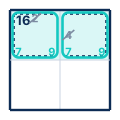
Cage Combination
Removes candidates Used in: Killer Sudoku
A cage total often allows only a handful of digit combinations. A two-cell cage summing to 16 can only be {7,9}; one summing to 4 can only be {1,3}. Listing the legal combinations prunes candidates fast and frequently leaves just one digit per cell.
Rule of 45
Places a digit Used in: Killer Sudoku
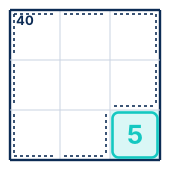
Every row, column, and box totals 45. Add up the cages that cover a region and compare with 45: the difference must live in the one cell that spills in (an “innie”) or out (an “outie”) of the region. A powerful way to crack open a fresh Killer grid.
Inequality Chain
Places a digit Used in: Futoshiki
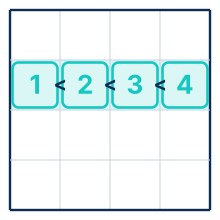
Follow the greater-than and less-than signs linking a run of cells. Each sign caps how high or low a value can be; a long enough chain of “<” signs on a small grid pins exact values — four cells reading a < b < c < d on a 4×4 must be 1, 2, 3, 4.
Advanced
X-Wing
Removes candidates Used in: Sudoku, Killer Sudoku
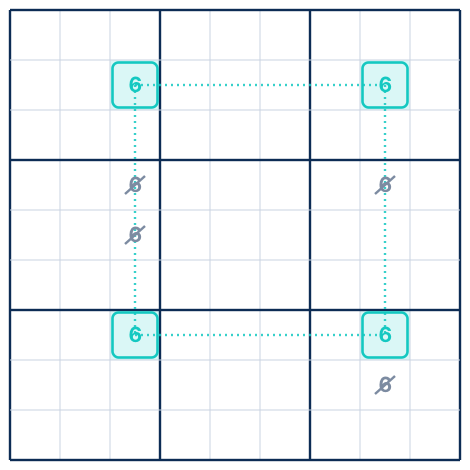
A digit’s candidates in two rows line up in the same two columns, forming a rectangle. The digit must occupy those two columns within those rows, so it can be removed from the rest of those columns.
Y-Wing
Removes candidates Used in: Sudoku, Killer Sudoku
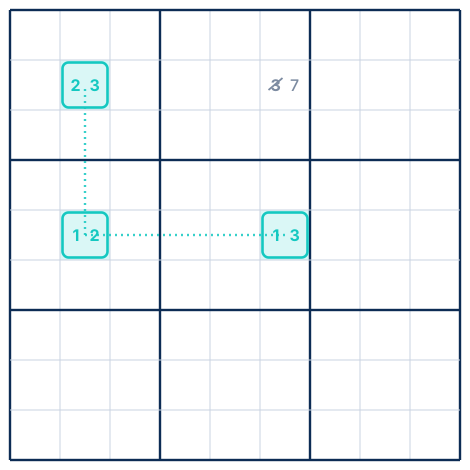
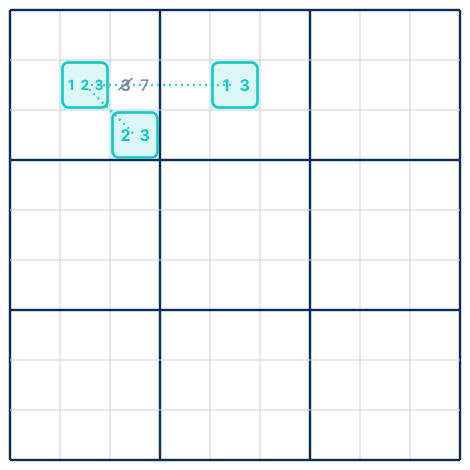
Also called the XY-Wing. A “pivot” cell with candidates {A,B} sees two “pincer” cells, one {A,C} and one {B,C}. Whichever value the pivot takes, one pincer is forced to C — so C can be eliminated from any cell that sees both pincers.
XYZ-Wing
Removes candidates Used in: Sudoku, Killer Sudoku
A stronger Y-Wing where the pivot itself carries three candidates {X,Y,Z} and the two pincers are {X,Z} and {Y,Z}. The digit Z is forced out of any cell that sees all three of the wing cells.
Skyscraper
Removes candidates Used in: Sudoku, Killer Sudoku
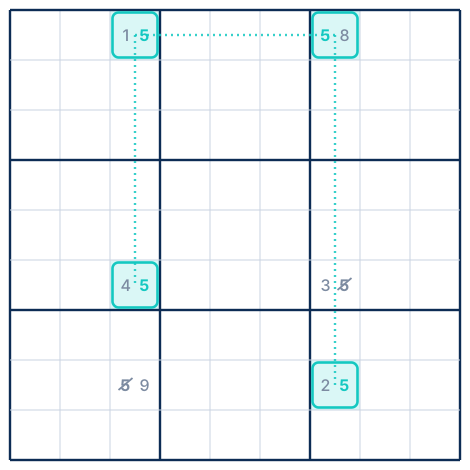
Two rows each have a digit confined to exactly two columns, and they share one of those columns (the “base”). The digit must lie in one of the two far ends (the “roofs”), so it is removed from any cell that sees both roofs.
Two-String Kite
Removes candidates Used in: Sudoku, Killer Sudoku
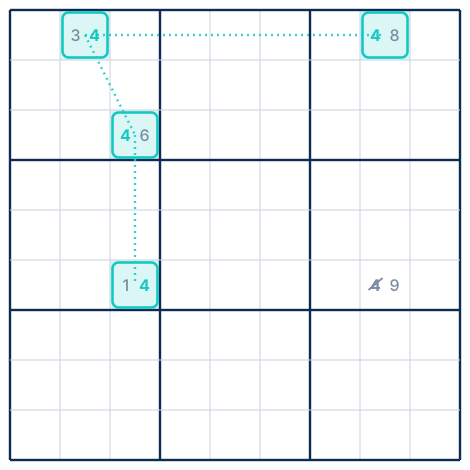
A row and a column each have a digit confined to two cells, and one end of each lands in the same box. The digit must then lie at one of the two free ends, so it can be removed from any cell that sees both of them.
Empty Rectangle
Removes candidates Used in: Sudoku, Killer Sudoku
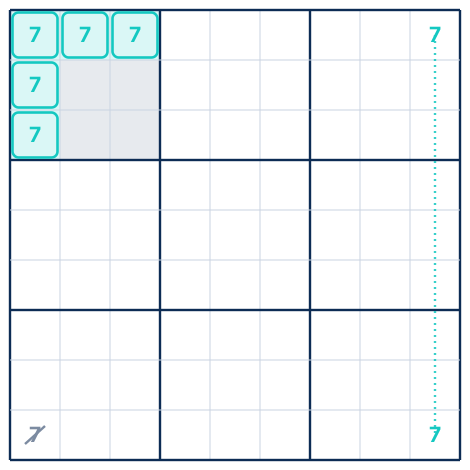
In one box, a digit’s candidates form an L-shaped pattern around an empty corner. Combined with a strong link for that digit elsewhere, one crossing candidate can be eliminated.

Naked Quad
Removes candidates Used in: Sudoku, Killer Sudoku, Calcudoku, Futoshiki
Four cells in a unit share only four candidate digits between them. Those four digits are reserved for those four cells and can be erased from the rest of the unit — the four-cell version of a naked pair or triple.

Hidden Quad
Removes candidates Used in: Sudoku, Killer Sudoku, Calcudoku, Futoshiki
Four digits are confined to the same four cells of a unit. Lock them into those cells and clear every other candidate from them, even though each cell still shows extra pencil marks.
W-Wing
Removes candidates Used in: Sudoku, Killer Sudoku
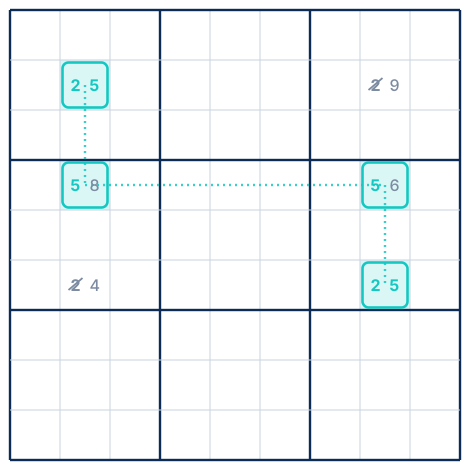
Two cells hold the same pair {A,B} and are joined by a strong link on B (a unit where B fits only two places). One of the pair must be A, so A is removed from any cell that sees both pair cells.
Expert
Swordfish
Removes candidates Used in: Sudoku, Killer Sudoku
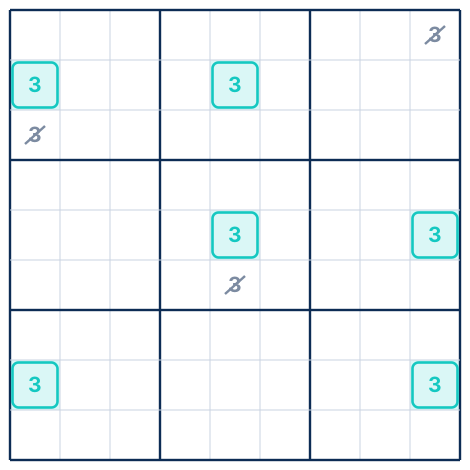
The three-line cousin of the X-Wing. A digit’s candidates across three rows occupy the same three columns (two or three per row). The digit must fill those three columns from the rows, so it is removed from those columns elsewhere.
Jellyfish
Removes candidates Used in: Sudoku, Killer Sudoku
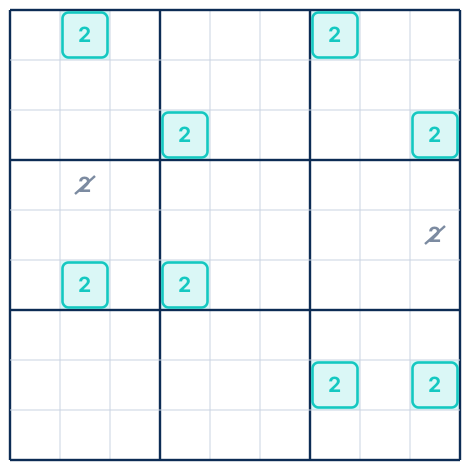
The four-line fish: a digit across four rows is confined to the same four columns. As with the X-Wing and Swordfish, the digit is then eliminated from those four columns in every other row.
Finned Fish
Removes candidates Used in: Sudoku, Killer Sudoku
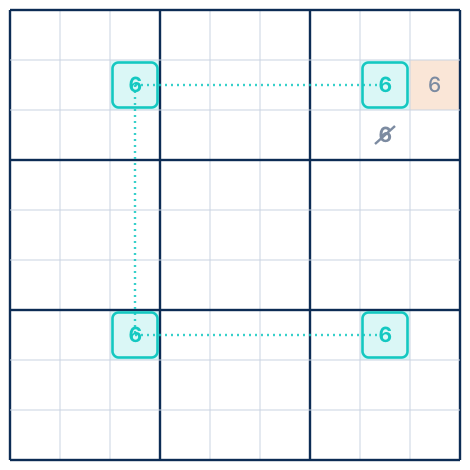
An almost-perfect fish with one or two extra candidates (the “fin”) in a single box. The eliminations still hold, but only for cover cells that also share that box with the fin.
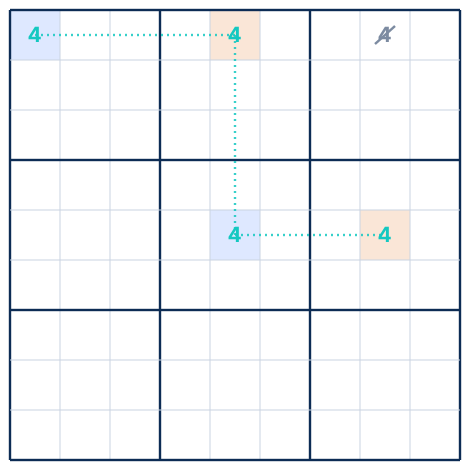
Simple Coloring
Removes candidates Used in: Sudoku, Killer Sudoku
Trace a digit through its conjugate pairs, alternately coloring the two ends of each strong link. If two cells of the same color see each other, that color is impossible; if a cell sees both colors, the digit is removed from it.
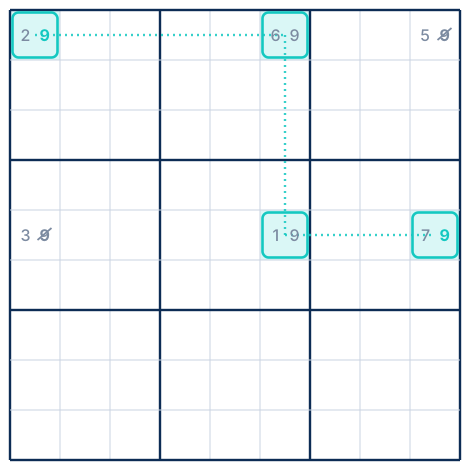
X-Chain
Removes candidates Used in: Sudoku, Killer Sudoku
A chain of strong and weak links on a single digit. Because the two ends cannot both be off, the digit is true at one end — so any cell that sees both ends cannot hold it.
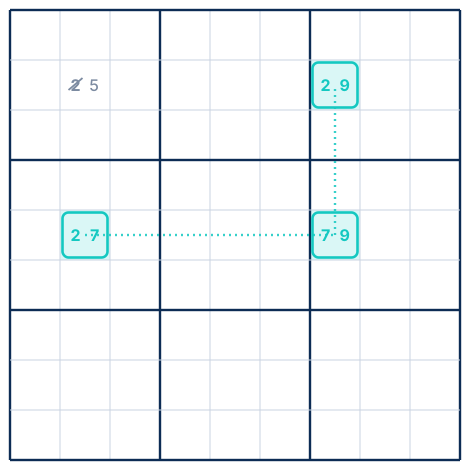
XY-Chain
Removes candidates Used in: Sudoku, Killer Sudoku
A chain of bi-value cells where each shares one candidate with the next. The same digit sits at both ends, one of which must be true, so it is eliminated from any cell that sees both ends of the chain.
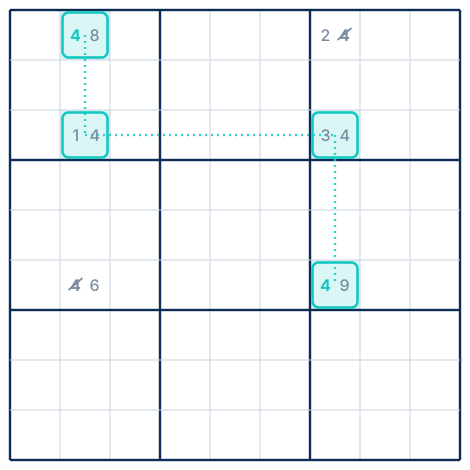
Inference Chain
Removes candidates Used in: Sudoku, Killer Sudoku
An Inference Chain weaves strong and weak links across different digits. Whatever the truth values along it, one of the two endpoints must hold — letting you eliminate any candidate that sees both ends.
ALS-XZ
Removes candidates Used in: Sudoku, Killer Sudoku
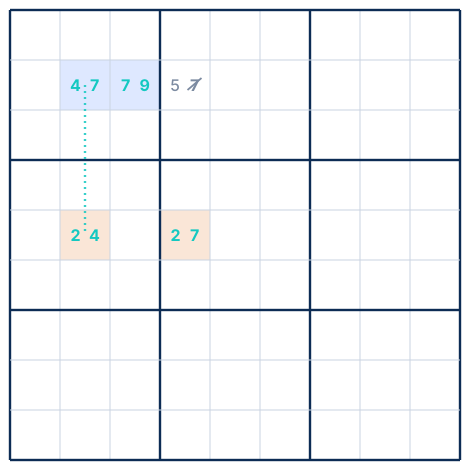
Two Almost Locked Sets are joined by a restricted common digit (X). That link forces a second shared digit (Z) into the sets, so Z can be removed from any cell that sees every Z candidate in both sets.